Updated June 2026 · Measurement Framework
How to Measure Startup PR ROI: A Complete Framework
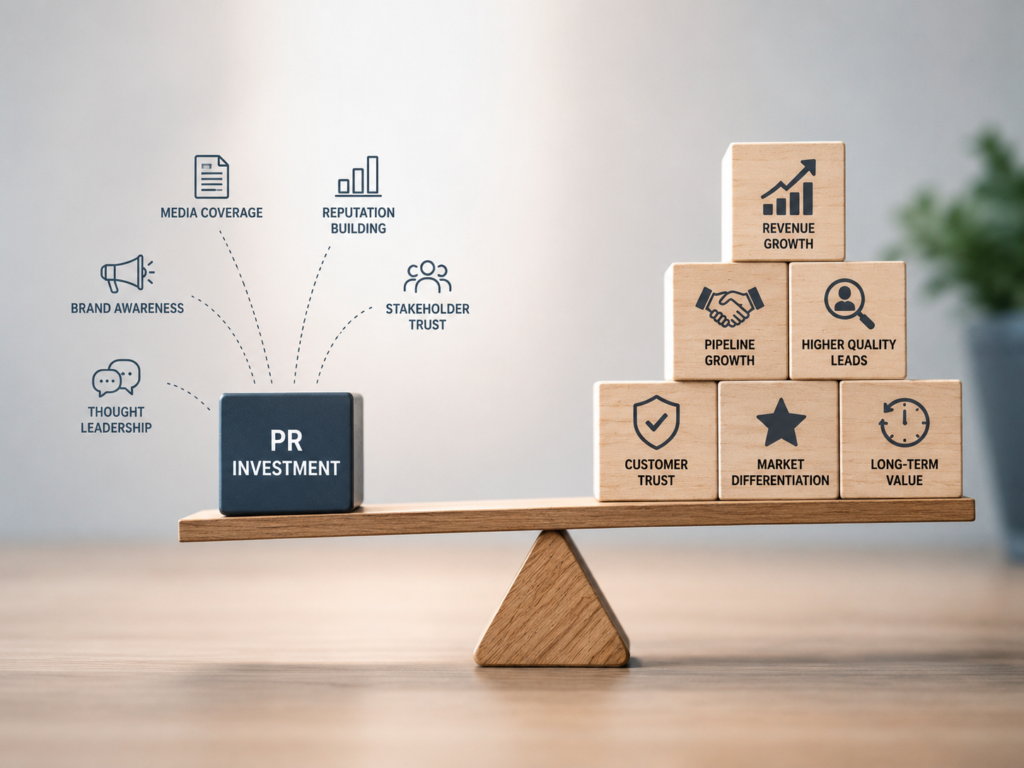 “How do we measure PR ROI?” is the question every founder asks — and the one most PR agencies struggle to answer convincingly. The honest truth: PR doesn’t operate like paid advertising where you can track a direct dollar-in, dollar-out return. But that doesn’t mean it’s unmeasurable. It means you need the right framework.

This guide provides a complete, practical system for measuring startup PR effectiveness — from traditional metrics to the new AI search visibility metrics that matter in 2026.
Why Traditional PR Metrics Are Broken
Before we get into what to measure, let’s address what not to measure — because the PR industry’s legacy metrics are responsible for most of the confusion around ROI:
- Impressions: “Your article reached 45 million people” sounds impressive until you realize it’s based on the outlet’s total monthly traffic, not the people who actually read your story. Impressions are meaningless vanity metrics.
- Ad Value Equivalency (AVE): This metric attempts to calculate what you would have paid for the same amount of advertising space. It’s been widely discredited by the industry’s own standards bodies. A 500-word article is not equivalent to a 500-word ad — they serve completely different purposes.
- Clip counts: “We got 47 articles this month” tells you nothing about quality, audience relevance, or business impact. 3 well-placed features in outlets your buyers read are worth more than 50 mentions on low-authority sites.
If your current PR agency reports primarily on these metrics, that’s a red flag. Ask them to shift to the framework below.
The Startup PR Measurement Framework
Effective PR measurement connects communications activities to business outcomes. Here’s a four-layer framework that works for VC-backed startups at any stage:
Layer 1: Output Metrics (What Did Your PR Produce?)
These are the basic activity metrics — necessary for tracking but insufficient on their own:
| Metric | What It Measures | Target Benchmark |
|---|---|---|
| Media placements | Number and quality of earned media hits | 3–8 meaningful placements/month |
| Placement quality tier | Tier 1, 2, or 3 outlets (by relevance to your audience) | 1–2 tier-one per quarter minimum |
| Thought leadership | Bylines, podcast appearances, speaking invites | 2–4 per month |
| Content produced | Blog posts, reports, social assets created from PR | 5–10 derivative pieces per placement |
Key nuance: Define your tiers by audience relevance, not by general prestige. For a cybersecurity startup, a feature in Dark Reading (niche but highly relevant) may be more valuable than a mention in Business Insider (broad but low-intent audience).
Layer 2: Outcome Metrics (What Did PR Influence?)
This is where measurement gets interesting — connecting PR activity to measurable business outcomes:
Website traffic from earned media:
- Use UTM parameters on all links shared via PR channels
- Track referral traffic from media outlet domains in Google Analytics
- Measure the traffic spike pattern: most placements generate a 24-48 hour spike, then a long tail as the article gets shared and indexed
- Benchmark: a good tier-one placement should drive 500-5,000 visits in the first week
Lead generation and pipeline influence:
- Add “How did you hear about us?” to your demo request and contact forms — include “Media/Press” as an option
- Track CRM records where PR-related touchpoints appear in the attribution chain
- Measure the conversion rate of PR-referred traffic vs. other channels (PR traffic typically converts higher because it comes with implicit credibility)
Domain authority and backlinks:
- Track your domain rating (DR/DA) monthly using Ahrefs or similar tools
- Count high-quality backlinks earned from media placements
- These SEO benefits compound over time and are one of PR’s most valuable — and most underappreciated — outputs
Social amplification:
- Track social shares, comments, and engagement on PR-related content
- Measure founder’s LinkedIn follower growth and post engagement
- Monitor Hacker News, Reddit, and community discussions mentioning your company
Layer 3: Impact Metrics (What Business Value Did PR Create?)
These are the metrics your CEO and board actually care about:
Revenue influence:
- Calculate the percentage of closed deals where PR appeared somewhere in the attribution chain
- Track “PR-assisted revenue” — deals where the prospect engaged with media coverage, thought leadership, or PR-driven content before converting
- Survey new customers about the role of media coverage in their decision-making process
Investor perception:
- Track inbound investor interest correlated with major placements
- Monitor whether VCs reference media coverage in conversations
- Note: this is harder to quantify but critically important — most VC-backed startups report that PR directly influenced their fundraising outcomes
Hiring velocity:
- Measure time-to-fill for key roles before and after sustained PR programs
- Track inbound candidate volume and quality
- Survey new hires about how they discovered the company
Competitive share of voice:
- Track media mentions for your company vs. 3-5 key competitors monthly
- Measure the ratio of your mentions to total category mentions
- A sustained PR program should steadily increase your share of voice over 6-12 months
Layer 4: AI Search Visibility (New in 2026)
This is the newest layer of PR measurement — and one that most agencies haven’t caught up to yet. In 2026, a significant and growing portion of your potential customers, investors, and partners use AI-powered search tools to research companies and categories. Your PR program’s impact on these AI systems is now measurable:
AI mention tracking:
- Query ChatGPT, Perplexity, Claude, and Google AI Mode monthly with your target questions: “What are the best [category] startups?” “Who are the leaders in [your space]?” “What should I look for in a [your product type]?”
- Document whether your company is mentioned, how it’s described, and what sources the AI cites
- Track changes month-over-month — successful PR should gradually improve your AI representation
AI source attribution:
- When AI systems cite sources, check whether your media placements appear in those citations
- Track which types of content (media features, original research, company blog posts) are most frequently cited by AI
- This data informs your content strategy — double down on the formats AI systems prefer to cite
GEO benchmarking:
- Maintain a list of 10-20 target queries that your ideal customers would ask AI systems
- Score each query monthly: 0 = not mentioned, 1 = mentioned but neutral, 2 = mentioned positively, 3 = recommended
- Track your aggregate GEO score over time — it should trend upward with sustained, quality PR
At BMV, we include AI search visibility tracking in our reporting for every startup PR engagement. It’s the metric that most clearly demonstrates the compounding value of earned media in 2026.
Setting Up Your PR Measurement System
Here’s a practical setup guide you can implement this week:
Tools you’ll need:
- Google Analytics (GA4) — for referral traffic, UTM tracking, and conversion measurement
- Ahrefs or Moz — for domain authority, backlink tracking, and keyword monitoring
- Media monitoring tool (Muck Rack, Cision, or even Google Alerts) — for tracking mentions
- A spreadsheet — for AI search visibility scoring (this is manual today but critical)
- Your CRM — for tracking PR-influenced pipeline and attribution
Monthly reporting template:
| Category | Metrics to Report | Frequency |
|---|---|---|
| Output | Placements by tier, thought leadership, content produced | Monthly |
| Traffic | Referral visits from media, UTM-tracked conversions | Monthly |
| SEO | Domain rating, new backlinks, keyword rankings | Monthly |
| Pipeline | PR-attributed leads, pipeline value, closed revenue | Monthly |
| Share of Voice | Mentions vs. competitors, category share | Quarterly |
| AI Visibility | GEO score across target queries, AI mentions | Monthly |
How to Calculate PR ROI (The Real Formula)
While PR doesn’t lend itself to simple cost-per-acquisition math, you can estimate ROI with this approach:
PR ROI = (Measurable value created by PR) ÷ (Total PR investment) × 100
Measurable value includes:
- Direct revenue: Deals where the prospect cited media coverage or PR-driven content
- SEO value: Estimated traffic value of backlinks earned (Ahrefs provides this)
- Equivalent paid media: What would you have paid to reach the same audience through advertising? (Use sparingly — this is directional, not precise)
- Hiring savings: Reduced recruiter fees and faster hiring correlated with increased visibility
- Fundraising premium: If PR contributed to a higher valuation, even a 1% improvement on a $50M round = $500K in value
Example: A Series A startup investing $10,000/month ($120K/year) in PR with a specialized startup PR agency might see:
- $400K in PR-influenced pipeline (deals where prospects engaged with media coverage)
- $25K in SEO value from backlinks earned
- $50K in recruiter fee savings from inbound candidates
- Immeasurable but real value in investor perception, competitive positioning, and AI search visibility
That’s $475K in measurable value on $120K spent — a 296% ROI before counting the intangible benefits. Most well-run startup PR programs generate 3-5x ROI within 12 months when measured comprehensively.
Common Measurement Mistakes
- Measuring too early. PR compounds over time. Evaluating ROI after 30 days is like judging a content marketing program after one blog post. Give it 6 months minimum before calculating meaningful ROI.
- Ignoring indirect attribution. Most PR impact is multi-touch. A prospect might see a Forbes article, then click a LinkedIn post, then visit your site directly a week later. If you only count last-touch attribution, you’ll systematically undervalue PR.
- Counting only media placements. PR’s value extends far beyond clip counts — relationship building, crisis prevention, executive positioning, and category creation all create business value that doesn’t show up as an “article.”
- Not tracking AI search at all. In 2026, ignoring how AI systems represent your company is like ignoring Google rankings was in 2010. Set up monthly AI visibility monitoring now — it takes 30 minutes and provides insights you can’t get any other way.
- Comparing PR to performance marketing. PR and paid acquisition serve different purposes. PR builds long-term brand equity and credibility that makes every other channel more effective. It’s an investment in compounding returns, not a direct-response mechanism.
The Compounding Effect: Why PR ROI Grows Over Time
The most important thing to understand about PR ROI is that it compounds. Unlike paid advertising (where results stop the moment you stop paying), PR benefits accumulate:
- Month 3: First placements landing. Early traffic and backlink value. Foundation being built.
- Month 6: Media relationships deepening. Consistent coverage. SEO benefits starting to compound. Domain authority rising.
- Month 9: Journalists proactively reaching out. Speaking invitations arriving. AI systems starting to include your company in responses.
- Month 12: Category authority established. Strong backlink profile. Measurable pipeline influence. AI search presence solidified. Your PR has created a durable competitive moat.
This compounding effect is why short PR engagements rarely produce meaningful ROI — and why the startups that commit to 12+ month programs see the strongest returns.
The Bottom Line
Measuring startup PR ROI requires moving beyond vanity metrics to a framework that connects PR activity to business outcomes. Track output metrics for accountability, outcome metrics for optimization, impact metrics for ROI calculation, and AI search visibility for future-proofing.
The startups that measure PR effectively are the ones that invest in it consistently — because they can see the compounding returns. The ones that don’t measure it effectively are the ones most likely to cut their PR budget at exactly the wrong time.
Set up the measurement framework described above. Give your PR program at least 6-12 months. And work with an agency that takes measurement seriously — not one that sends you impression counts and clip reports.
Want a PR program with real measurement?
Talk to BMV about results-driven startup PR →