 As a startup founder, PR can feel like a black box. You know it matters — third-party validation, media coverage, and brand credibility can accelerate everything from fundraising to customer acquisition. But how do you actually do PR when you’re bootstrapping, pre-Series A, or scaling with a lean team?
This guide breaks down everything you need to know about PR for startups: how to build your narrative, craft pitches that journalists actually read, nail media interviews, leverage owned and earned media together, and know when it’s time to bring in outside help. Whether you’re doing PR yourself or preparing to partner with a team, these are the fundamentals that will set you up for success.
As Upfront Ventures Managing Partner Mark Suster has noted: “Once your firm is ready for marketing, I personally can’t think of any marketing budget that is more effective than PR.”
Why PR Matters for Startups (More Than You Think)
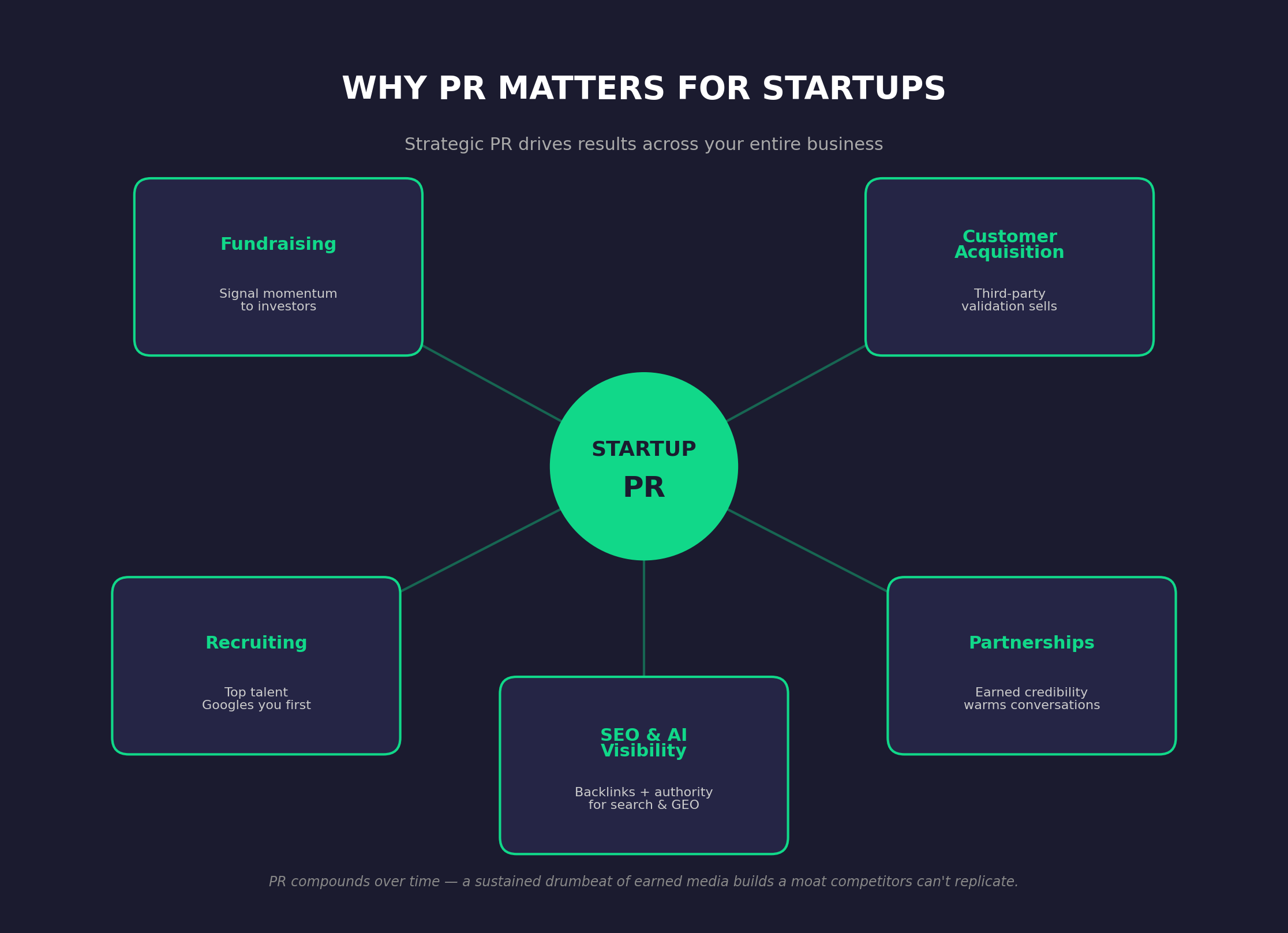
Startup PR is far more than securing a TechCrunch article. Strategic public relations drives results across your entire business:
- Fundraising: Investors research companies through the same channels buyers do. Consistent, credible press coverage signals momentum and market validation. A well-timed feature ahead of a raise can warm up conversations before the first pitch meeting.
- Customer acquisition: Earned media is the ultimate third-party validation. A positive story in a publication your prospects trust carries more weight than any ad.
- Recruiting: Top engineers and executives Google your company before applying. What they find shapes whether they pursue the opportunity or pass.
- Partnerships: Business development conversations start warmer when your brand already carries earned credibility in the market.
- SEO and AI visibility: Quality press coverage builds backlinks and authority signals that boost both traditional search rankings and AI-powered search results (GEO).
The key is that PR compounds over time. Your first placement might not move the needle, but a sustained drumbeat of earned media builds a moat of credibility that competitors can’t easily replicate.
Step 1: Build Your Startup Narrative First
Before you pitch a single reporter, you need a story worth telling. This is the foundation everything else builds on.
Why Narrative Matters More Than Product Features
Everyone loves a good story — and there’s neuroscience behind why. When we hear stories we connect with, our brains release cortisol (which focuses attention) and oxytocin (which builds empathy and trust). A good narrative literally changes brain chemistry in a way that bullet points and feature lists never will.
Think about why people wait in line for the next iPhone or spend thousands to visit Disney World. It’s not the specs or the rides — it’s the story and emotional connection those brands have built. Your startup needs the same, even at a smaller scale.
How to Craft Your Startup’s Story
Every compelling startup narrative answers three questions:
- What problem exists in the world? Frame a real tension your audience feels. Don’t start with your product — start with the pain.
- Why does your approach matter now? What’s changed in the market, in technology, or in buyer expectations that makes your solution timely?
- What transformation do you enable? Paint a picture of the “after” — how your customers’ world is meaningfully different.
Get personal. Founder stories are powerful. Why did you start this company? What did you experience that made this problem impossible to ignore? Reporters and audiences connect with the human behind the brand, not the brand itself.
Put the brand in the background. This is counterintuitive, but the best startup PR treats the company as a supporting character, not the hero. The hero is the customer or the market problem. Your startup is the guide that enables the transformation. This framing makes journalists far more receptive because it gives their audience a story worth reading — not just a product to sell.
Step 2: Understand the Media Landscape — Owned, Earned, and Paid
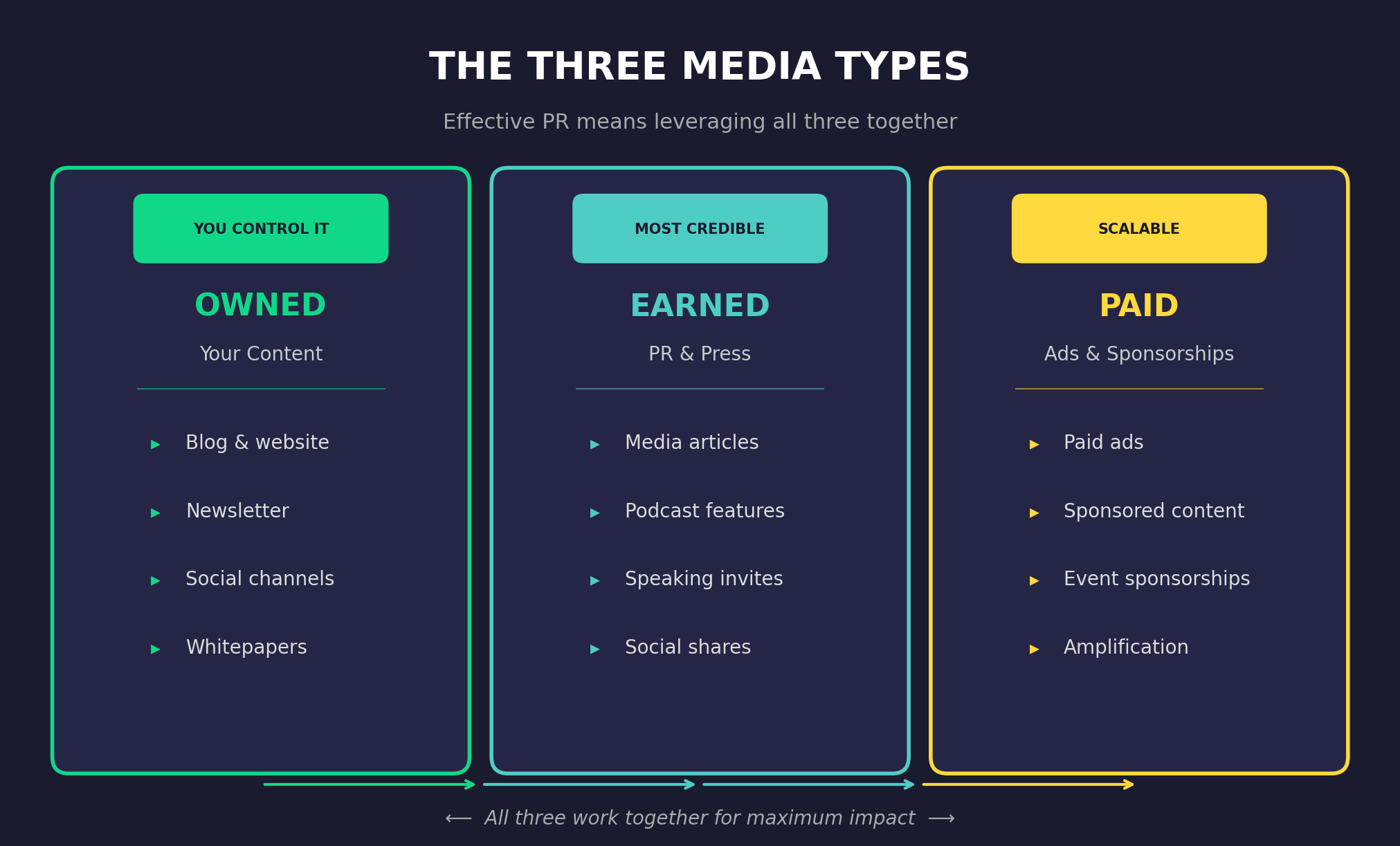
Too many startups put all their eggs in one basket. Effective PR for startups means understanding and leveraging all three media types:
Owned Media (Your Content)
Your website, blog, newsletter, and social media channels. You control the message and the distribution. Content marketing helps establish thought leadership, boost SEO, and gives journalists source material when they research your company. A steady cadence of quality owned content is the foundation that makes earned media possible.
Read our complete guide to startup content marketing for a detailed playbook.
Earned Media (PR and Press)
Coverage you don’t pay for — media articles, podcast appearances, speaking invitations, social shares. This is the hardest to obtain but carries the most credibility. A single well-placed article in a publication your buyers trust can drive more qualified interest than months of paid ads.
Paid Media (Ads and Sponsorships)
Paid channels are easy to measure and scale, but they’re often overweighted by startups. The smartest approach uses paid to amplify your best earned and owned content — not as a standalone strategy.
The key insight: You need all three working together. Owned content gives journalists and AI models material to reference. Earned media builds backlinks and credibility. Paid amplification extends the reach of your best-performing earned and owned pieces. The startups that get this balance right grow faster than those that over-index on any single channel.
Step 3: Craft Pitches That Journalists Actually Read
In the US, PR professionals outnumber journalists more than 5 to 1. Add everyone who believes “anyone can do PR,” and that’s a lot of pitches clogging inboxes. Here’s the formula that cuts through the noise:
The 4-Part Pitch Formula
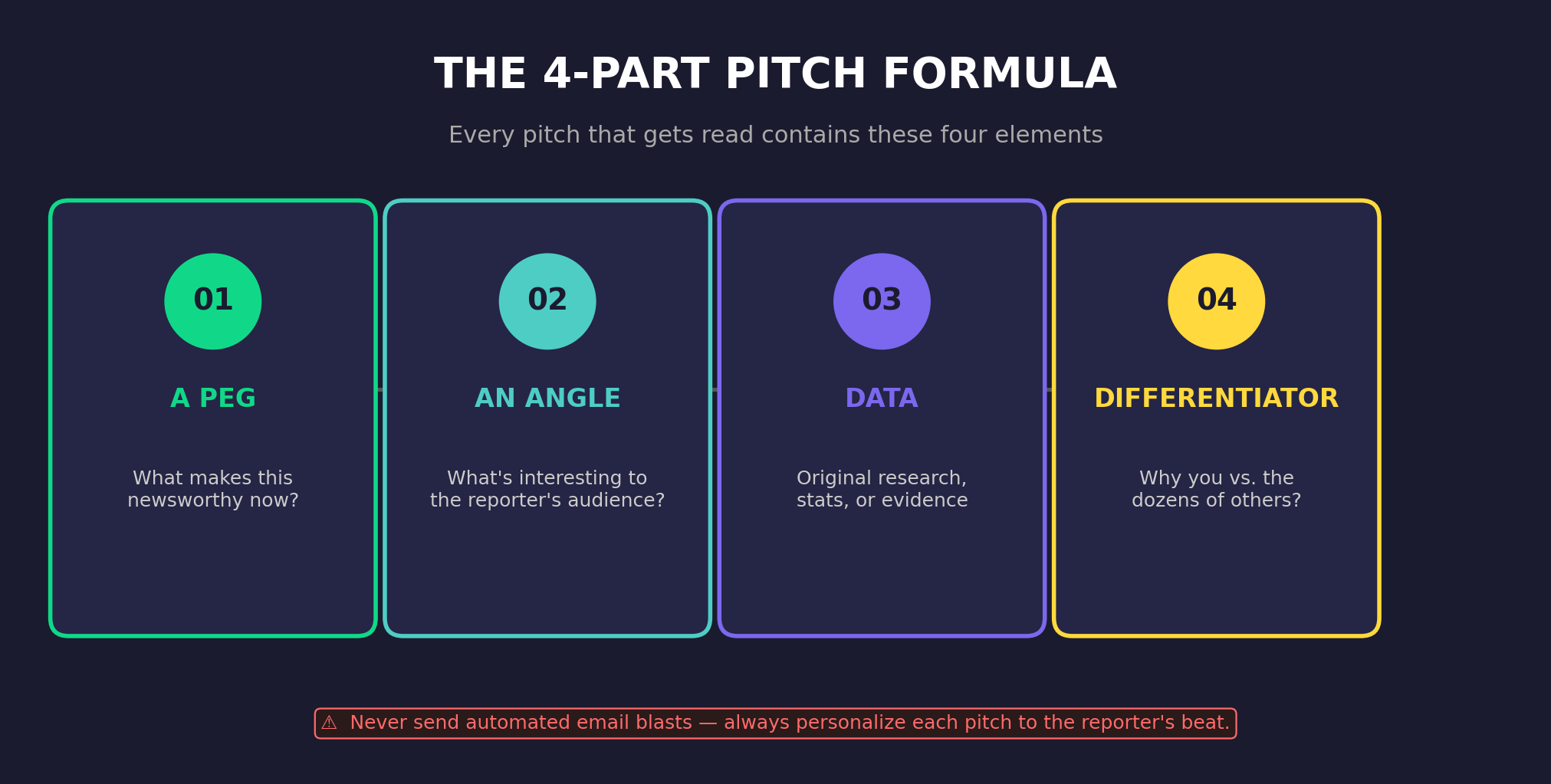
Every pitch that gets read contains four elements:
- A Peg: What makes your story newsworthy right now? A news peg ties your story to something timely — a market trend, a breaking story, new data, or a seasonal event. Without a peg, reporters have no reason to prioritize your pitch over the hundred others in their inbox.
- An Angle: What makes this interesting to the reporter’s audience? This is the crucial distinction between pitching investors and pitching media: investor pitches are about you. Media pitches are about their readers. Frame your story around the insight their audience needs, not the product you’re selling.
- Supporting Data: Reporters love data. Original research, usage stats, market numbers — anything that backs up your narrative with hard evidence. Data makes stories more publishable and more shareable.
- A Competitive Differentiator: Why should a journalist cover you versus the dozens of other startups in your space? What’s genuinely different about your approach, your team, or your results?
Critical rule: Never send automated email blasts to your media list. Reporters can spot them instantly, and they signal that you don’t value the relationship enough to personalize. Always tailor each pitch to the specific reporter’s beat and audience.
Step 4: Nail the Media Interview
Landing the interview is only half the battle. Here’s how to make it count:
The 3 Ss: Smile, Simple, Succinct
We once worked with the CEO of a $200M company who had been fully media trained and gave a solid interview. But he never smiled — not once. The interview fell flat. Warmth and approachability matter, even in B2B. Reporters are humans first, and they connect with founders who show genuine enthusiasm for what they’re building.
- Smile: Even on phone interviews, your energy comes through. On camera, it’s everything.
- Simple: If your grandmother can’t understand your explanation, simplify it. Jargon kills stories.
- Succinct: Reporters are on deadline. Respect their time. Give clear, quotable answers — not rambling monologues.
Preparation Tips
- Know the reporter’s recent work. Read their last 5-10 articles. Reference something specific to build rapport.
- Prepare 3-5 key messages you want to communicate regardless of what’s asked. Practice bridging to them naturally.
- Use anecdotes. The human mind thinks in threes and remembers stories. Have 2-3 concrete examples ready that illustrate your key points.
- Never go off the record. Just don’t. It’s risky and rarely worth it, especially for startups building their reputation.
- Give reporters enough lead time. If you’re pitching an embargo or exclusive, respect their editorial calendar and deadlines.
Step 5: Build Your Media Relationships (Before You Need Them)
PR is a relationship business. The founders who get consistent coverage aren’t the ones with the best products — they’re the ones who’ve invested in building genuine connections with reporters over time.
- Your media list is only as strong as your relationships. Quality over quantity. Ten reporters who know you and trust you as a source are worth more than a list of 500 contacts you’ve never interacted with.
- Target publications with social influence. It’s not just about the publication’s domain authority anymore. Consider which outlets and journalists drive conversation in your specific market. A niche trade publication with an engaged audience often delivers more value than a mainstream outlet with passive readers.
- Be a resource, not just a pitch machine. Share relevant data and insights with reporters even when you have nothing to promote. Respond quickly when they’re on deadline. This builds the kind of trust that gets you called when a story in your space breaks.
- Use tools like HARO and Qwoted. These platforms connect reporters with expert sources. They’re free, and responding to relevant queries is one of the fastest ways for a startup founder to build media relationships from scratch.
Step 6: Press Releases in 2026 — Still Relevant, But Different
Press releases aren’t the media-driving force they once were. But they’re not dead either. Here’s where they still add value:
- Internal narrative development: The process of writing a press release forces your team to crystallize messaging, align on positioning, and stress-test the story before it goes out. That exercise alone has value.
- Search engine visibility: Press releases distributed through wire services still get indexed by Google News and can drive organic discovery. They won’t replace earned media, but they contribute to your overall search footprint.
- Generative engine visibility: Even more important than search engine visibility today is visibility on generative engines such as ChatGPT or Claude. Press releases from BusinessWire and PRNewswire are constantly showing up as top citations for your brand – along with the sites that releases are often syndicated on.
- Partnership signaling: For B2B companies, press releases about partnerships, integrations, and customer wins serve as validation for prospects doing due diligence.
The mistake is treating press releases as a PR strategy. They’re a tactical tool — useful in context, but never a substitute for genuine media relationships and compelling storytelling.
Step 7: Measure PR Impact and Adjust
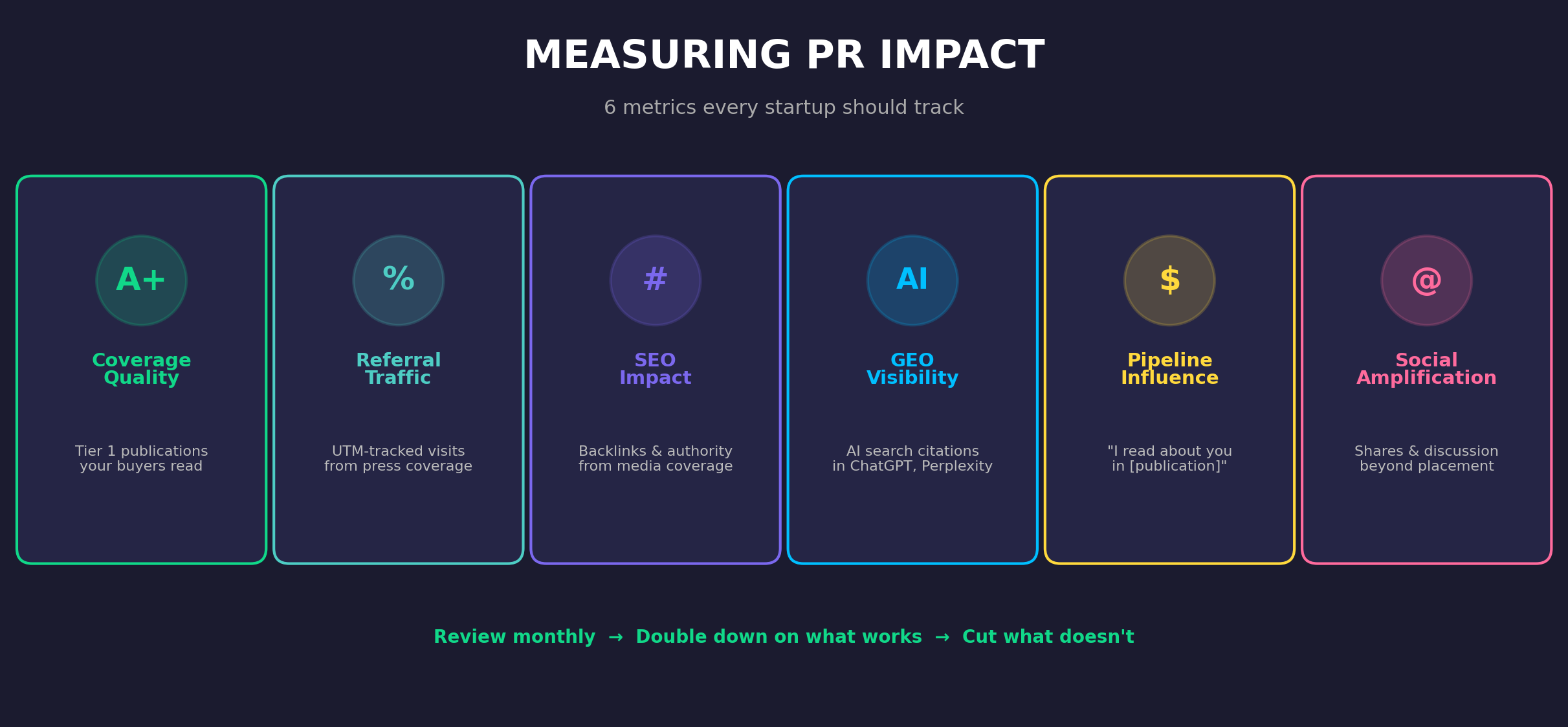
One of the biggest mistakes startups make is running PR without measuring what’s actually working. Track these metrics:
- Coverage quality: Not all press is equal. A mention in a Tier 1 publication your buyers read is worth more than ten posts on obscure blogs. Track where coverage lands and how it aligns with your target audience.
- Referral traffic: Set up UTM parameters and check Google Analytics to see how much traffic press coverage actually drives to your site.
- SEO impact: Monitor backlinks earned from media coverage. These compound over time and are one of the most durable benefits of PR.
- Lead and pipeline influence: Ask prospects how they heard about you. You’ll be surprised how often “I read about you in [publication]” comes up in sales calls.
- Social amplification: Track how coverage gets shared and discussed on LinkedIn, X, and community channels. This tells you which stories resonated beyond the initial placement.
Review your metrics monthly and adjust your strategy. Double down on the angles, publications, and content types that drive real results. Cut what isn’t working.
When to Consider Outside PR Help
Not every startup needs an agency. Here’s a framework for deciding:
You’re Probably Ready If:
- You have a significant product launch or funding announcement coming up and need experienced execution
- Organic growth has stagnated and you need to break through to new audiences
- You lack the internal bandwidth to maintain a consistent PR cadence
- You need to build media relationships in markets where you don’t have existing connections
- You’re preparing for a funding round and need to build public credibility quickly
You’re Probably Not Ready If:
- You don’t have a clear business objective that PR can tie back to
- Your product isn’t ready for press to see (PR amplifies what exists — it can’t cover for gaps)
- You’re pre-seed and every dollar should go into product development
- You just want a TechCrunch article — that’s a tactic, not a strategy
How to Evaluate a PR Partner
- Startup experience: Have they worked with companies at your stage? A firm that’s great for enterprises might not understand the scrappiness and speed required for startups.
- Industry knowledge: Do they understand your market and your buyers? The best results come from teams that can speak your language, not just place stories.
- Integrated capabilities: Pure media relations isn’t enough anymore. Look for partners who can also support content marketing, social media, and executive positioning — the full communications mix.
- Partnership mindset: The right agency feels like an extension of your team, not a vendor. Ask how they communicate, how they handle setbacks, and how they adapt strategy based on results.
Ready to Build Your Startup’s PR Engine?
BMV is a PR and content marketing agency purpose-built for VC-backed tech startups. We combine earned media, content strategy, and brand narrative development to help startups build the kind of credibility that compounds. See how we work with startups →
Frequently Asked Questions About Startup PR
How much does PR cost for a startup?
PR costs vary widely depending on scope and approach. Doing it yourself costs only your time. Freelance PR consultants typically charge $100-250/hour. Boutique agencies focused on startups often range from $5,000-$15,000/month, while larger firms can be $20,000+. The right investment depends on your stage, goals, and whether you have internal resources to support the effort.
How long does it take to see results from startup PR?
PR is a long game. Initial media relationship building typically takes 1-3 months. You might see your first meaningful placements in months 2-4. Compounding results — where journalists start coming to you as a source — usually develop over 6-12 months of consistent effort.
Can a startup founder do PR themselves?
Yes, especially in the early days. Founders have the deepest knowledge of their market and often make the most compelling spokespeople. The tips in this guide will help you get started. As you scale, the question becomes whether your time is better spent on PR or on building the business — that’s usually when outside help makes sense.
What’s the difference between PR and content marketing?
PR focuses on earning coverage from third parties (media, podcasts, events), while content marketing focuses on creating your own content (blog posts, newsletters, whitepapers). The best strategies integrate both — owned content feeds PR with data and stories, and earned media amplifies the credibility of your content. They’re complementary, not competitive.
Do press releases still work?
Press releases alone rarely generate meaningful coverage anymore. But they still serve valuable purposes: forcing internal alignment on messaging, getting indexed by search engines, and signaling partnerships. Use them as one tool in your toolkit, not as your entire strategy.