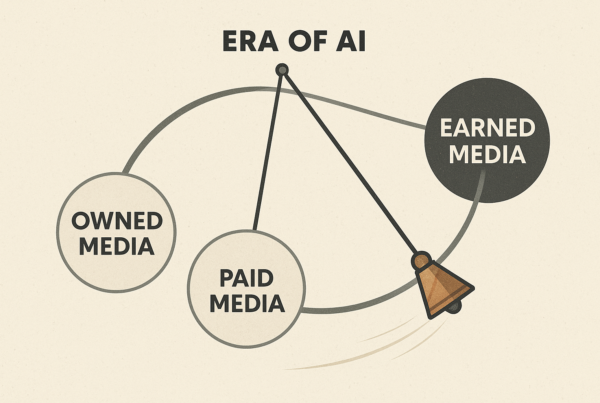
When OpenAI’s board abruptly removed Sam Altman in late 2023, where did the tech world turn for real-time updates and analysis? Not first to traditional outlets like The Wall Street Journal or CNBC, but to direct, founder-led and analyst-driven channels: live commentary on X, in-depth breakdowns on Substack, and long-form conversations on influential podcasts like All-In.
That moment wasn’t an anomaly. It marked a permanent acceleration in how technology stories are told, discovered, and trusted.
Since then, major developments — from large language model launches to platform acquisitions and infrastructure shifts — have increasingly unfolded through direct community engagement, not traditional press-first strategies. In 2026, this reality is unavoidable: the traditional tech PR playbook is no longer sufficient on its own.
Today’s founders announce product updates on podcasts instead of press releases. Engineering leaders build credibility through GitHub discussions and long-form technical blogs rather than contributed media placements. Executives use LinkedIn as a primary communications channel, shaping narratives in real time. Meanwhile, AI is fundamentally changing how audiences discover and evaluate information.
If you’re still approaching tech public relations the way you did five years ago – focusing exclusively on outlet lists and announcement-driven coverage – you’re not just behind. You’re operating in a different ecosystem than your audience.
Let’s explore how successful technology companies are reshaping tech PR strategies in 2026, and why everything from your content strategy to your success metrics needs a rethink. This isn’t just another cycle of media transformation—it’s a complete reimagining of how technical stories are discovered, shared, and amplified.
The New Tech Media Ecosystem
The monopoly of traditional tech media gatekeepers has eroded substantially. We’ve seen this transformation clearly in how technical news spreads: when Rust made its landmark announcement about the Rust Foundation’s new partnership with AWS, the most impactful discussions happened not in tech publications, but through community channels like the official Rust Discord server and core team members’ personal blogs. Similarly, when Stripe launched their machine learning tools, the announcement gained traction not through traditional PR channels, but through detailed technical discussions on their engineering blog and subsequent community engagement on platforms like Hacker News.
The ecosystem now includes voices that would have been considered fringe just a few years ago. Take the case of Cassidy Williams, whose technical newsletter has become a must-read source for frontend development insights, often breaking news about framework updates before traditional tech media. Or consider the impact of Kent C. Dodds, whose technical workshops and community platforms now influence developer tool adoption more directly than conventional tech media coverage. Even traditional tech companies like Intel are adapting, with their engineers regularly hosting Reddit AMAs and detailed GitHub discussions about their latest innovations.
AI’s Reshaping of Discovery and Distribution
The rise of AI-powered search engines marks a fundamental shift in information flow. When developers search for information about new technologies, they’re increasingly likely to encounter AI-synthesized responses that pull from multiple sources. We’ve seen this play out with companies like Snowflake, whose technical documentation and community discussions now rank higher in AI search results than their traditional marketing materials.
Similarly, New Relic’s developer relations team has adapted by focusing on creating detailed technical content that gets referenced and validated by community experts, rather than relying on traditional SEO strategies. The speed of information flow has also transformed crisis communication in tech. When Cloudflare experienced a significant service disruption last quarter, their response wasn’t a carefully crafted press statement, but a real-time incident response thread on X, complemented by their status page and engineering team’s detailed technical explanations on their blog. This transparent, multi-channel approach has become the new standard for technical crisis communication.
Tech Content in the Age of AI
While AI tools can scale content production, authentic expertise remains paramount. Look at how Confluent approaches technical content: they combine AI-assisted research and writing with deep technical expertise from their engineering team. Their blog posts and technical documentation are enhanced by AI tools, but still grounded in practical experience and real-world implementation details.
Similarly, Elastic’s approach to technical content combines AI-powered insights with authentic engineering perspectives, creating resources that resonate with their technical audience while maintaining depth and accuracy. The success of platforms like Driveway.app’s engineering blog demonstrates this balance perfectly. Their technical content team uses AI tools to help with research and initial drafts, and relies on their engineers’ expertise for the insights and analysis that make their content valuable. This approach has helped them build a devoted following among infrastructure engineers, proving more effective than traditional marketing approaches.
The Social Media Evolution
Let us not forget the power of social media. Today’s social landscape for tech communication continues to evolve in unexpected ways. While Twitter/X’s dominance in tech discussions may be waning, LinkedIn has become increasingly central to technical discourse — though its growing popularity presents new challenges for visibility in a crowded landscape. Meanwhile, platforms like Bluesky are emerging as potential new homes for technical discussions.
What matters isn’t the platforms themselves, but understanding how technical audiences use them. Engineering leaders might share detailed technical insights on LinkedIn while developers debate implementation details on specialized forums or Discord servers. Success requires understanding these nuanced usage patterns and adapting content and engagement strategies accordingly.
Measuring Impact in the New Landscape
Traditional PR metrics like impression counts and advertising equivalency have become vestigial remnants of a simpler time. Modern tech PR requires sophisticated measurement approaches that consider the complex ways technical information flows through communities. This means tracking media mentions as well as understanding how tech discussions evolve and spread across platforms.
Effective measurement now requires understanding multiple layers of impact: immediate engagement in tech communities, influence on developer adoption, effects on enterprise decision-making processes, and ultimately, impact on business metrics like developer adoption and sales pipeline. This complexity demands new tools and approaches to measurement that can track influence across diverse technical communities and platforms.
Building a Future-Proof Tech PR Strategy
Success in tech PR today requires a fundamental shift in how we think about it altogether. Instead of viewing it as a broadcast mechanism, we need to see it as a tool for fostering genuine discussions and unique community engagement to the multiple hives of influence that have now taken root all across the Internet. This means developing new capabilities in AI and automation while maintaining the human expertise and authentic technical voice that audiences demand.
The most successful tech companies in 2026 will be those that can navigate this complex landscape, building genuine connections with technical audiences while leveraging new tools and platforms to amplify their reach and impact. They’ll understand that success isn’t just about reaching the right outlets—it’s about starting the right conversations in the right communities.
So, What Now?
The transformation of tech PR represents both a challenge and an opportunity for rethinking communications strategies for technology organizations today — whether you are a startup or a Fortune 500 company. While the landscape is undoubtedly more complex than ever, it also offers unique opportunities to reach and engage audiences in meaningful ways. Success will come to those who can balance traditional PR skills with new capabilities in AI, community building, and multi-platform engagement. The best Tech PR agencies in this new world will be able to guide you through the process and strategize the best strategy to maximize your brand’s influence.
Your technical audiences are already engaged in deep, meaningful conversations across multiple platforms. The question isn’t whether to adapt to this new reality — it’s how quickly you can transform your approach to become part of these essential discussions.